

What Is ASCLEPIOS™
ASCLEPIOS™ is an integrated software solution designed to manage all aspects of a hospital’s operations — including clinical, administrative, financial, and legal functions.
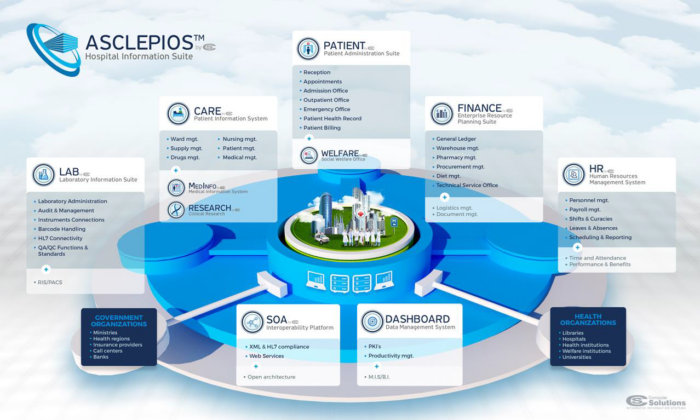
Core Modules in ASCLEPIOS™
- Patient Registration and Admissions
- Outpatient Management
- Ward Management
- Electronic Health Records (EHR)
- Emergency (Triage)
- Laboratory Information System (LIS)
- Picture Archiving and Communication System (PACS)
- Radiology Information System (RIS)
- Pharmacy Management
- Operating Room (OR)
- Billing & Insurance
- Human Resources & Payroll
- Inventory & Supply Chain
- Biomedical Equipment / Technical Service
- Diet
How Does a ASCLEPIOS™ Work
ASCLEPIOS™ works by digitally connecting hospital departments, enabling real-time data sharing, process automation, and better management. Here’s how it typically functions:
1. Patient Registration
- When a patient arrives, their personal, medical, and insurance details are entered into the system.
- A unique ID is generated and used across all hospital services.
- Handle outpatient, inpatient, and emergency admissions.
2. Clinical Management
- ASCLEPIOS™ integrates with Electronic Medical Records (EMR) to manage:
- Diagnoses
- Lab and imaging orders
- Prescriptions
- Treatment plans
- Progress notes
- Doctors, nurses, and other staff access and update records digitally.
- Access lab results, radiology reports, prescriptions, clinical notes, and more.
3. Laboratory & Diagnostic Integration
- Lab and radiology departments receive test requests electronically.
- Once results are ready, they are automatically sent to the patient’s file in ASCLEPIOS™ for review.
4. Pharmacy Integration
- Prescriptions are sent directly to the hospital pharmacy.
- The system checks for drug interactions, allergies, and inventory availability.
5. Billing and Insurance
- All services provided (tests, medication, consultations) are captured and priced automatically.
- Insurance claims are generated based on recorded data and can be sent electronically to payers.
6. Administrative Functions
- ASCLEPIOS™ manages:
- Inventory and supply chain
- Equipment usage and maintenance
- Room and bed allocation
6. Laboratory Information System (LIS)
- Order, track, and receive lab test results.
- Interface with lab equipment for seamless data capture.
7. Radiology Information System (RIS)
- Manage imaging orders and reports (X-rays, MRI, CT scans).
- Supports image storage through PACS (Picture Archiving & Communication System).
8. Pharmacy Management
- Track prescriptions, inventory, dispensing, and stock alerts.
- Supports drug interaction checks and barcode-based dispensing.
9. Ward & Bed Management
- Monitor bed occupancy and patient transfers.
- Manage ward admissions, discharges, and bed assignments.
10. Operation Theater (OT) Scheduling
- Schedule and manage surgeries.
- Track pre-op and post-op details, checklists, and staff assignments.
11. Nursing Station
- Nursing care planning, medication schedules, vitals monitoring, and shift handovers.
12. Human Resource & Payroll
- Manage staff profiles, attendance, scheduling, payroll, and leaves.
13. Financial Accounting
- Handle hospital income, expenses, asset tracking, and ledger reports.
14. Inventory & Procurement Management
- Track supplies (medical & non-medical), reorder levels, and vendor management.
15. Insurance & TPA Integration (optional)
- Manage claims, pre-authorizations, billing, and follow-ups with third-party payers.
16. Telemedicine Support (optional)
- Enable remote consultations and virtual follow-ups.
17. Alerts & Notifications
- Auto-reminders for appointments, medication schedules, or abnormal test results.
18. Reporting & Analytics
- ASCLEPIOS™ generates reports for:
- Hospital performance
- Financial summaries
- Patient outcomes
- Regulatory compliance
- Useful for hospital management and accreditation bodies.
- Generate clinical, financial, and operational reports.
- Support for dashboards and KPIs for hospital performance monitoring.
19. Security & Role-Based Access
- Ensures data privacy through controlled access and audit trails.
- Role-based permissions ensure only authorized personnel can view or modify sensitive data.
- All actions are logged for audit and compliance purposes.
20. Compliance & Standards
- Adheres to standards like HL7, ICD-10, etc.
21. Integration with National Health Systems (where applicable)
- Sync with public health databases, national ID systems, or government portals.
Benefits of Using ASCLEPIOS™
Improved Patient Care
- Enables fast and accurate access to complete patient records, helping clinicians make better treatment decisions.
Accurate and Automated Billing
- Automatically captures services rendered for accurate billing, reducing financial errors and claim rejections.
Centralized Data Management
- Stores all hospital data (clinical, administrative, financial) in one integrated system for easy access and management.
Streamlined Hospital Operations
- Automates workflows across departments like admissions, pharmacy, labs, and billing — improving efficiency.
Reduced Patient Waiting Times
- Faster registration, test ordering, and result delivery minimize delays in patient care.
Enhanced Diagnostic Accuracy
- Access to complete medical history and lab results supports more accurate diagnoses and treatment plans.
Clinical Decision Support
- Built-in alerts (e.g., drug interactions, allergy warnings) help avoid medical errors and support evidence-based decisions.
Reduced Medical Errors
- Digital prescriptions, standardized forms, and real-time data sharing reduce human error in care delivery.
Better Departmental Coordination
- Connects departments like labs, radiology, pharmacy, and billing, ensuring seamless information flow and collaboration.
Real-Time Data and Reporting
- Provides dashboards and reports for clinical, financial, and administrative performance monitoring.
Efficient Inventory Management
- Tracks medications, medical supplies, and consumables to prevent stockouts or overstocking.
Cost Reduction
- Cuts administrative overhead, paper usage, and manual processes, leading to significant savings.
Enhanced Data Security
- Role-based access controls, encryption, and audit logs help protect sensitive patient information.
Better Appointment and Bed Management
- Schedules appointments, tracks bed availability, and manages patient admissions and discharges efficiently.
Simplified Insurance Claims
- Streamlines insurance processes by auto-generating claims with accurate service and coding data.
Improved Staff Productivity
- Automates repetitive tasks, reduces paperwork, and allows clinicians to focus more on patient care.
Integrated Laboratory and Radiology Management
- Orders and results are managed electronically, speeding up testing processes and reducing lost reports.
Support for Research and Quality Improvement
- Collects data that can be used for audits, quality metrics, clinical research, and policy development.
Compliance with Standards and Regulations
- Helps hospitals meet legal, ethical, and accreditation requirements (e.g., ISO) through built-in compliance tools.
Key Features of ASCLEPIOS™
ASCLEPIOS™ is an integrated software solution designed to manage all aspects of a hospital’s operations — clinical, administrative, financial, and logistical.
🔹 1. Patient Registration & Admission
- Capture and manage patient demographic data.
- Assign patient IDs or MRNs (Medical Record Numbers).
- Handle outpatient, inpatient, and emergency admissions.
🔹 2. Appointment Scheduling
- Manage bookings for consultations, diagnostics, and surgeries.
- Allows online appointment requests and reminders.
🔹 3. Electronic Medical Records (EMR/EHR)
- Store and manage patient health records.
- Access lab results, radiology reports, prescriptions, clinical notes, and more.
🔹 4. Billing & Invoicing
- Automate billing for services, procedures, medications, and consultations.
- Manage insurance claims and payment tracking.
🔹 5. Laboratory Information System (LIS) Integration
- Order, track, and receive lab test results.
- Interface with lab equipment for seamless data capture.
🔹 6. Radiology Information System (RIS)
- Manage imaging orders and reports (X-rays, MRI, CT scans).
- Supports image storage through PACS (Picture Archiving & Communication System).
🔹 7. Pharmacy Management
- Track prescriptions, inventory, dispensing, and stock alerts.
- Supports drug interaction checks and barcode-based dispensing.
🔹 8. Ward & Bed Management
- Monitor bed occupancy and patient transfers.
- Manage ward admissions, discharges, and bed assignments.
🔹 9. Operation Theater (OT) Scheduling
- Schedule and manage surgeries.
- Track pre-op and post-op details, checklists, and staff assignments.
🔹 10. Nursing Station
- Nursing care planning, medication schedules, vitals monitoring, and shift handovers.
🔹 11. Human Resource & Payroll
- Manage staff profiles, attendance, scheduling, payroll, and leaves.
🔹 12. Financial Accounting
- Handle hospital income, expenses, asset tracking, and ledger reports.
🔹 13. Inventory & Procurement Management
- Track supplies (medical & non-medical), reorder levels, and vendor management.
🔹 14. Insurance & TPA Integration
- Manage claims, pre-authorizations, billing, and follow-ups with third-party payers.
🔹 15. Telemedicine Support (optional)
- Enable remote consultations and virtual follow-ups.
🔹 16. Alerts & Notifications
- Auto-reminders for appointments, medication schedules, or abnormal test results.
🔹 17. Reporting & Analytics
- Generate clinical, financial, and operational reports.
- Support for dashboards and KPIs for hospital performance monitoring.
🔹 18. Security & Role-Based Access
- Ensures data privacy through controlled access and audit trails.
🔹 19. Compliance & Standards
- Adheres to standards like HL7, ICD-10, HIPAA, SNOMED, etc.
🔹 20. Integration with National Health Systems (where applicable)
- Sync with public health databases, national ID systems, or government portals.
In Summary
A modern HIS is a comprehensive solution that integrates various departments and functions of a hospital into a single unified platform, enhancing efficiency, data accuracy, patient care quality, and resource management.

Tell us more about your project needs
Sign up to receive our news and updates